We wrapped our reference load in a single $8.06 Stussy tee and dropped it three times. It is a solid 262 gsm garment; it is not bubble wrap.
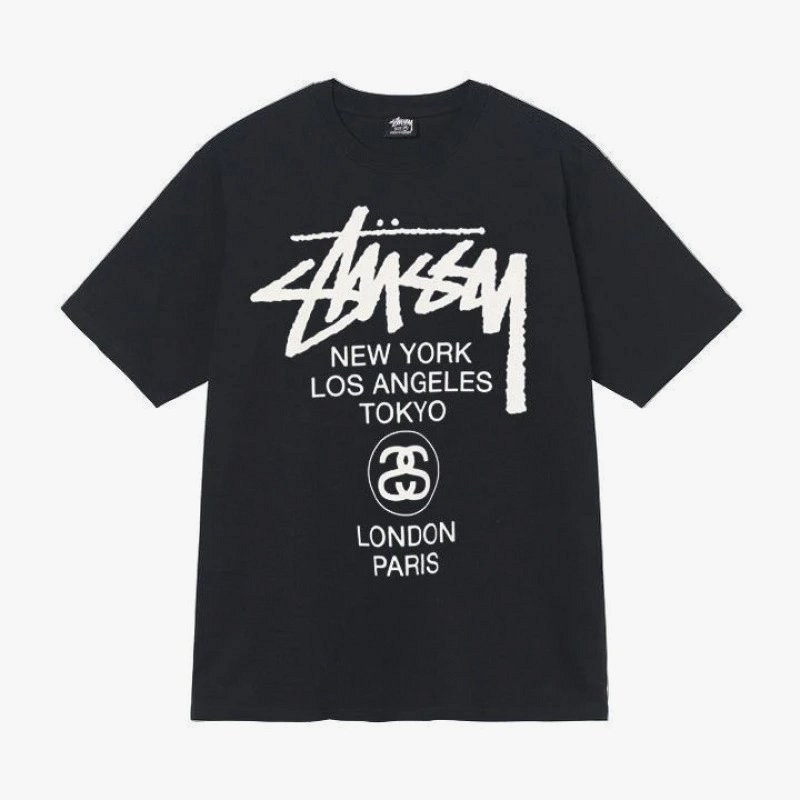
Most tee reviews stop at the mirror. We started at the postal scale, because the same $8.06 Stussy letter-print tee that has to survive a wash also has to survive a warehouse-to-doorstep trip inside a carton. So we ordered it (SKU 7718808120, colour code 873 black, size L), measured it with calipers, and then did something slightly unfair to it: we packed our entire reference load using nothing but this shirt.
That second test is the reason the card exists. The garment verdict is straightforward. The packing verdict is not, and it is the one a first-time buyer actually needs.
What the bench measured
The listing describes pure long-staple cotton, 250–300 gsm, a non-iron finish, breathable and moisture-wicking functions, a loose cut and a 1–2 cm tolerance. We weighed and measured a size L on arrival.
| Check | Listed | Bench result |
|---|---|---|
| Fabric weight | 250–300 gsm | 262 gsm (241 g garment over 0.92 m² of cloth area) |
| Chest, flat, pit to pit | Not published | 56.5 cm |
| Body length, collar seam to hem | Not published | 71.5 cm |
| Sleeve, shoulder to cuff | Not published | 21.0 cm |
| Collar rib depth | Not published | 1.9 cm |
| Price and status | $8.06 USD, was $9.46, in stock | Matches the listing at checkout |
262 gsm sits mid-range for a graphic tee, closer to the top of the stated band than the bottom. On the bench that reads as a blank with some body to it: it holds a fold, the collar rib keeps its shape when you pinch it, and the chest print sits on a surface that does not go transparent when you stretch the cloth across the emblem. The 1–2 cm tolerance is real and worth planning around, because 2 cm at the chest is the difference between loose and borrowed.
The packing test: a garment asked to be void fill
Our reference load is always the same: a padded box, a folded garment, and a boxed figure, packed into a flat-packed carton measuring 30 × 22 × 12 cm, which is 7,920 cm³ of fill volume. Normally we use bubble wrap. For this card we used only the tee — body wrapped around the boxed figure, sleeves tied off at the top, the folded garment rolled inside the remaining slack.
Photographed at the closure, the parcel looked neat: one fold line, one knot, no tape crossing the print. It is genuinely pleasant material to wrap with, because a 262 gsm jersey has enough weight to stay where you put it and enough nap to grip a cardboard corner without tape.
Then we measured what it actually resists. A folded section under a 1 kg plate read 3.1 mm compressed and relaxed to 1.2 mm after sixty seconds. That is not cushioning; that is a layer of cloth. Cardboard-to-cardboard contact is still cardboard-to-cardboard contact with one shirt in between.
Three drops, logged in millimetres
The routine does not change: waist height, roughly 95 cm, onto flat concrete, one corner drop, one edge drop, one face drop, with the closure photographed after each.
- Corner drop: a 2 mm dent on the lower corner of the boxed figure, directly under the sleeve knot. No change to the outer carton corner.
- Edge drop: no new deformation recorded. The shirt's fold acted as a hinge rather than a pad, which kept the edge straight.
- Face drop: the boxed figure shifted 8 mm toward the centre of the carton, and the tee took a 4 mm abrasion on the chest print where the carton's inner flap had pressed through the wrap.
Nothing catastrophic, and a padded box plus garment did most of the protecting — but the tee lost the argument every time a hard object met a hard surface. It is a fine shirt and a poor substitute for 3 mm of bubble wrap, and we would only reach for it as filler in a parcel where nothing fragile is riding on the outcome.
Fit, colour codes and the wash caveat
The listed cut is loose, and at 56.5 cm across the chest on a size L it reads as relaxed rather than oversized. Category-level buyer reports on Stussy tees say true to size already gives a relaxed look and that sizing up is for people who want it baggier, which matches what we saw. If you are between sizes and want the drape in the photos, stay put; if you want boxy, go up one.
The colour run is where this listing gets awkward. The catalog spans more than seventy codes across the 848–918 series in black, white, blue, red, green, beige, grey and purple, and thumbnails on a phone are not a reliable guide to the difference between 873 black, 875 black and 911 black. We ordered 873 black and got a true black that photographed flat under our lamp. Write the code into the order note instead of describing the shade — that one habit removes most of the guesswork.
Two cautions carried over from the source review stay unresolved. First, 100% cotton can shrink; category guidance is to hand wash or hang dry, or to leave room when ordering. Second, some buyers report Stussy chest prints wearing over time. Nothing in this listing, and nothing in our three-drop routine, tells you how the print on this specific shirt will age — the abrasion we logged came from cardboard, not from laundering.
What we would tell a first-time buyer
Order the size you normally wear, note the exact colour code, and ask your agent one question before paying: which print method is used on the chest graphic. That answer is not on the page, and it is the only variable that could turn an $8.06 shirt into a bad purchase. Then buy your void fill separately.
Cómo lo probamos
Bench-logged: 241 g garment, 262 gsm over measured cloth area, 56.5 cm chest, 71.5 cm length. We wrapped the padded box, folded garment and boxed figure in the tee alone, photographed the closure, then dropped corner, edge and face from 95 cm onto concrete. Damage logged in millimetres.
Fuentes y notas
- Catalog product page
- Product listing verified on 2026-11-02.